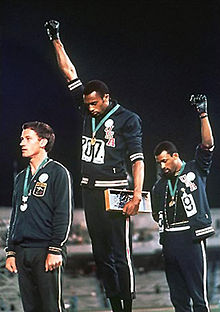
Prior to the 1968 Olympic games in Mexico City, many politicians in the U.S. came together to put down the civil rights movement by Blacks. There was a great deal of speculation in the track and field world that Black athletes would unite and boycott the 1968 games. However, after much discussion, athletes felt that winning a medal was far more important to themselves and their families than to stage a boycott. They felt that they had worked too hard to give up an opportunity to seek the various Olympic medals.
These attitudes effectively ended any chance of an Olympic boycott and were to the joy, and relief of international, and U.S. Olympic Committees. "Tommy and I did not share the feelings about winning medals held by many of the other athletes." It is difficult to say whether the gesture by Carlos and Smith were made for the improvement of the Black athlete's conditions yet in 1991, when Sports Illustrated convened a roundtable and asked a number of outstanding Black and White athletes if things had been better for them in the 1970s and 80s, most agreed that a number of things had improved.
The roundtable consisted of such luminaries as Hank Aaron, Anita de Frantz and Bill Walton. Relationships between Black and White players and between Black player and management on professional teams seemed, in the panelists' eyes, very similar to the past. They noted that the most significant progress had been made in large salaries that were paid to bona fide superstar African Americans, notably, at the time, Magic Johnson in basketball, Bo Jackson in football and baseball, and Dwight Gooden in baseball. Expressing overriding concerns beyond considerations of current salary figures, the roundtable pointed out that generally Black athletes, because of poor college preparation, were not prepared for life after professional sports.
Revised: July 18, 2013.